Technical knowledge
Duplex 2205 vs super duplex 2507: choosing the right duplex grade
Composition, PREN, strength and cost comparison of duplex 2205 against super duplex 2507, with decision guidance for subsea, desalination, seawater injection and chemical duty.
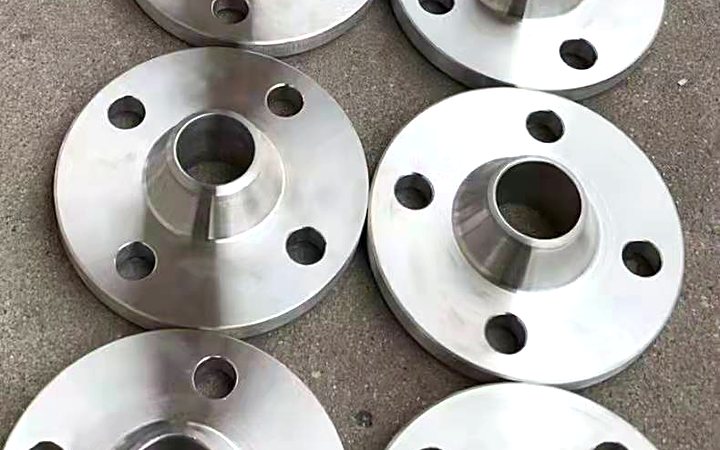
Chemistry and resulting microstructure
Both alloys contain roughly equal austenite and ferrite, giving strength above that of either phase alone plus immunity to chloride stress corrosion cracking. The difference is alloy level: 2205 has 22 % chromium, 3 % molybdenum and about 0.17 % nitrogen, while 2507 has 25 % chromium, 4 % molybdenum and about 0.27 % nitrogen. That higher alloy content is what drives both the strength and the pitting resistance - and also the risk of sigma phase if heat treatment is wrong.
Side by side data
| Property | Duplex 2205 (S32205) | Super duplex 2507 (S32750) |
|---|---|---|
| UNS | S32205 | S32750 |
| Chromium | 22 - 23 % | 24 - 26 % |
| Molybdenum | 3.0 - 3.5 % | 3.0 - 4.0 % |
| Nitrogen | 0.14 - 0.20 % | 0.24 - 0.32 % |
| Typical PREN | 35 - 38 | Above 40 |
| Tensile strength min | 620 MPa | 800 MPa |
| Yield strength min | 450 MPa | 550 MPa |
| Max hardness | 293 HB / 31 HRC | 310 HB / 32 HRC |
| Continuous temperature limit | About 300 °C | About 300 °C |
| Typical cost index | 1.0 | 1.3 - 1.5 |
When super duplex earns its premium
- Subsea flowlines, manifolds and risers where inspection and repair costs are extreme.
- Seawater injection and produced water systems with high chloride and elevated temperature.
- Reverse osmosis high pressure piping where 800 MPa tensile allows thinner, lighter pipe.
- High velocity lines with erosion corrosion risk, because the higher strength and PREN act together.
- Sour service where NACE MR0175 listing at a controlled maximum hardness of 32 HRC is required.
When duplex 2205 remains the smarter buy
There is no benefit to boosting PREN if the environment does not need it. For ambient seawater, structural applications, storage tanks, chemical tankers, most pulp and paper duties and general process piping, 2205 delivers the same doubling of yield strength over 316L and better chloride SCC resistance at lower cost and with easier fabrication.
Fabrication caution that applies to both grades
Warning Sigma phase precipitation between roughly 550 °C and 1000 °C destroys toughness in duplex alloys. Always specify solution annealed and water quenched material, control interpass temperature below 150 °C during welding, and never slow cool through that range.
Use the correct over-alloyed filler - ER2209 for 2205 and ER2594 for 2507 - to restore the phase balance and pitting resistance of the weld metal, and verify with ferrite measurement plus hardness testing recorded on the certificate.
Questions about this topic
Is duplex stainless steel magnetic?
What is the maximum continuous service temperature?
Can I weld 2507 using 2209 filler?
How do I check that duplex material is free of sigma phase?
Are these grades acceptable under NACE MR0175?
Questions about our products
What products does Hangbo Alloy supply?
Which alloy grades are available for these products?
What sizes, wall thicknesses and pressure classes can you supply?
Which material and dimensional standards do you work to?
Is there a minimum order quantity?
What inspection and certification is issued with the goods?
What are typical lead times?
How are the products packed for export?
How do I request a quotation or a sample?
Talk to an engineer
Share your duty conditions and we will shortlist candidate alloys within one working day.