Technical knowledge
How to choose a flange material for corrosive service
A practical five-step method for selecting flange material in corrosive service: identify the fluid, rank the failure modes, shortlist alloys by PREN and temperature, then verify hardness, bolting and certification before ordering.
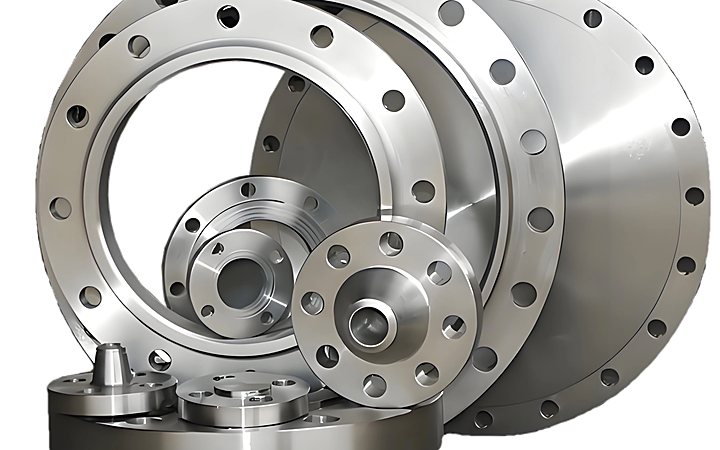
Step 1 - Start with the fluid, not the flange
Most wrong alloy choices begin with a specification copied from a previous project rather than with the actual stream analysis. A plant that nominally handles 'seawater' may actually be handling seawater dosed with sodium hypochlorite, contaminated by H2S during shutdown, or stagnant for weeks between batches. Each of those conditions moves the material requirement in a different direction, and the difference between 316L and Inconel 625 is far cheaper than one unplanned shutdown.
Collect the full stream analysis before you shortlist: pH, chloride content, oxidising species such as ferric and cupric ions, H2S partial pressure, operating and upset temperatures, velocity, stagnant periods and any cleaning chemicals. Upset conditions usually control the selection, not normal operation.
Step 2 - Rank the failure modes that actually apply
Different mechanisms demand different answers, and no single alloy solves all of them. Ranking them first prevents both over-specification and nasty surprises.
- Pitting and crevice corrosion - driven by chlorides plus stagnant geometry. Use PREN as the first filter.
- Chloride stress corrosion cracking - affects every austenitic stainless steel above roughly 60 °C; duplex and nickel alloys are immune or very resistant.
- Sulphide stress cracking - requires NACE MR0175 / ISO 15156 compliance and hardness control, not just a corrosion resistant alloy.
- General corrosion - often decides between reducing acids, where molybdenum matters, and oxidising acids, where chromium matters.
- Erosion corrosion - high velocity or entrained solids demand hardness and a strong passive film, pointing to duplex or titanium.
Step 3 - Shortlist alloys using PREN and temperature
Pitting resistance equivalent number (PREN = %Cr + 3.3 x %Mo + 16 x %N) is a fast screening tool, not a design method, but it sorts candidates efficiently. Read it together with the maximum metal temperature because several high PREN alloys lose toughness or crevice resistance above certain limits.
| Material | Typical PREN | Approximate limit in seawater | Typical role |
|---|---|---|---|
| 316L | About 26 | Atmospheric, low chloride | Lowest cost, general service |
| Duplex 2205 | 35 - 38 | Immersed seawater, to about 30 °C | High strength seawater systems |
| Super duplex 2507 | Above 40 | Hot brine, high velocity | Subsea, desalination, HP injection |
| 254SMO (S31254) | Above 43 | Seawater heat exchangers | Single phase alternative to duplex |
| Incoloy 825 | 30 - 33 | Sulphuric acid duty | Acid and sour produced water |
| Inconel 625 | 45 - 51 | Hot seawater, sour service | Offshore, FGD, wellhead |
| Hastelloy C-276 | Above 65 | Mixed acid duty | Chemical reactors, scrubbers |
| Titanium Grade 2 | Not applicable | Unlimited practical range | Chlorine, seawater, desalination |
Tip Titanium does not use PREN because it does not pit by the same mechanism. Where chlorides dominate and the temperature is below about 80 °C, compare titanium against high nickel alloys on installed cost, not on corrosion data alone.
Step 4 - Match the bolting, gasket and facing to the flange
Specifying a Hastelloy flange with carbon steel studs guarantees galvanic corrosion of the bolts and a seized joint at the next shutdown. Match the whole joint.
- Bolting. ASTM A193 B8M Class 2 for general stainless duty, ASTM A453 Grade 660 for high temperature, Inconel 718 where relaxation resistance and sour compliance are both needed.
- Gaskets. Spiral wound with PTFE or graphite filler to ASME B16.20; use BX or RX ring joints only with correctly hardened RTJ grooves.
- RTJ hardness. The groove must be harder than the ring so the ring deforms, not the flange. Agree the hardness window in the purchase order.
- Coatings and isolation. Use insulating gasket kits when joining dissimilar metals, particularly nickel alloys to carbon steel.
Step 5 - Specify certification before you buy, not after
The material certificate is the only proof you will ever have of what was actually delivered. State the following in the purchase order so there is nothing to negotiate later:
- Material specification and UNS number for flange, bolting and gasket, with dimensional standard (ASME B16.5 or B16.47 series).
- EN 10204 3.1 certificate as standard, plus an SGS third party test report when the project needs independent verification.
- NDT scope: ultrasonic testing, dye penetrant on machined surfaces, PMI coverage percentage.
- Hardness limits, especially for sour service to NACE MR0175 or for ring type joint grooves.
- Marking requirement to MSS SP-25 so that the heat number survives to the installed asset.
Hangbo issues all of these as standard documentation and can consolidate flange, bolting and gasket certificates into one package so your audit trail has no gaps.
Questions about this topic
Can I use 316L flanges on a seawater line to save money?
What is the most common cause of leaking alloy flanges?
What documentation is issued with the material?
Should I always specify PMI testing?
Is Inconel 625 always better than duplex for offshore use?
Questions about our products
What products does Hangbo Alloy supply?
Which alloy grades are available for these products?
What sizes, wall thicknesses and pressure classes can you supply?
Which material and dimensional standards do you work to?
Is there a minimum order quantity?
What inspection and certification is issued with the goods?
What are typical lead times?
How are the products packed for export?
How do I request a quotation or a sample?
Talk to an engineer
Share your duty conditions and we will shortlist candidate alloys within one working day.