Technical knowledge
Inconel 625 weld overlay: the economical way to buy corrosion resistance
How Inconel 625 weld overlay and cladding work on carbon steel flanges and fittings: process options, dilution control, thickness, inspection and when solid alloy is still the better answer.
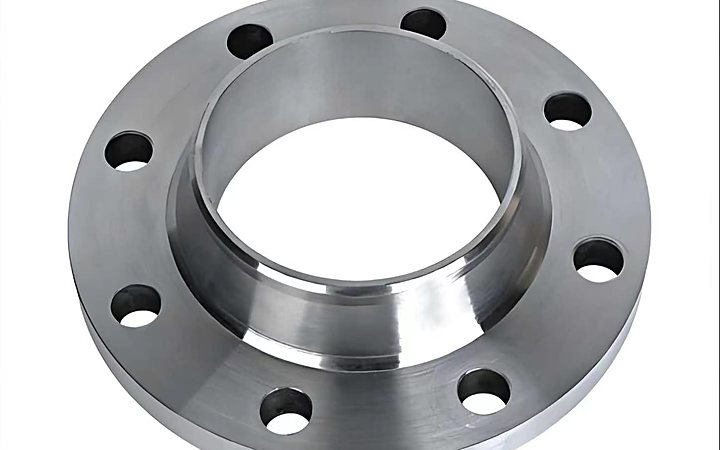
Process options and what they give you
- Manual or mechanised gas tungsten arc welding. Low dilution and precise control, preferred for sealing faces and small bore bores.
- Submerged arc or electroslag strip cladding. High deposition rate for large surfaces, with dilution managed through the flux and the number of layers.
- Explosion bonding or roll bonding. Produces a metallurgically bonded clad plate used for spades, blinds and vessel components.
Dilution is the controlling variable. The first layer picks up iron from the substrate, which lowers the molybdenum and niobium content of the deposit. Two layers are normally specified so that the surface chemistry meets the 625 requirement after dilution.
Thickness, coverage and where overlay belongs
| Area | Typical finished thickness | Notes |
|---|---|---|
| Raised face and groove | 3 mm minimum after machining | Verify by positive material identification after final machining |
| Bore | 2 to 4 mm | Mechanised welding gives the most consistent coverage |
| Ring type joint groove | Full coverage plus hardness agreement | Confirm the groove is harder than the ring |
| Weld end bevel | Butter to complete the transition | Allows a matching filler joint to the pipe |
Inspection that must be written into the order
- Dye penetrant examination of the finished overlay surface after machining.
- Ultrasonic examination for bond integrity where the design requires it.
- Positive material identification of the finished surface to confirm the chemistry after dilution, not just of the filler wire.
- Thickness verification at defined locations, with a minimum finished thickness stated in the purchase order.
- Documentation of the welding procedure specification, procedure qualification record and welder or operator qualification.
When solid alloy is still the better answer
Overlay is not always cheaper or safer. Choose solid Inconel 625 when the section is thin, when the component will be repeatedly machined or repaired, when the service temperature creates a large thermal expansion mismatch with the substrate, or when the geometry makes consistent coverage impossible to achieve and verify.
Questions about this topic
How thick should an Inconel 625 overlay be?
Can overlay be repaired in the field?
Is an overlay flange as strong as a solid flange?
Questions about our products
What products does Hangbo Alloy supply?
Which alloy grades are available for these products?
What sizes, wall thicknesses and pressure classes can you supply?
Which material and dimensional standards do you work to?
Is there a minimum order quantity?
What inspection and certification is issued with the goods?
What are typical lead times?
How are the products packed for export?
How do I request a quotation or a sample?
Talk to an engineer
Share your duty conditions and we will shortlist candidate alloys within one working day.